
In the ISO 9000 family, quality is the degree to which the inherent characteristics of something meet requirements. The definition is in ISO 9000:2015, the vocabulary standard that ISO 9001 relies on. ISO 9001 itself does not redefine the word. Quality, in this sense, is a measure of fit between what a product or service is and what was required of it. It says nothing about luxury or price.
The definition, part by part
The ISO wording is short and each part does work. We paraphrase it here, because the standard's text is copyrighted.
"Degree" means quality is a matter of more or less. A product can meet its requirements well, poorly or partly, which is why people speak of good, poor or excellent quality.
"Inherent characteristics" are features that belong to the thing itself: the diameter of a shaft, the response time of a help desk, the accuracy of an invoice. A characteristic that is assigned from outside, such as the price or the owner, is not part of quality in this definition.
"Object" is anything you can describe: a product, a service, a process, a person, an organization or a system. This is why the same definition works for a machined part and for a consulting engagement.
"Requirements" are needs or expectations. ISO 9000 says they can be stated, generally implied or obligatory. That three-way split is the most useful part of the definition, and the next section looks at it.
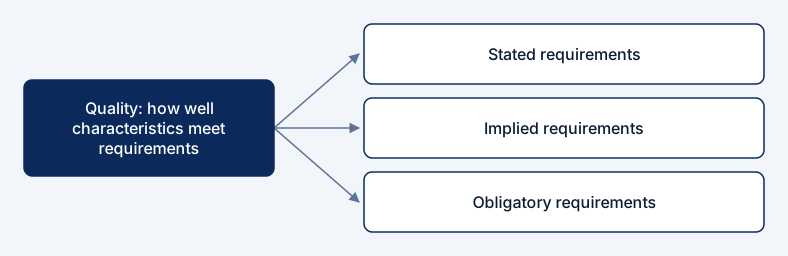
Three kinds of requirement
Stated requirements are written down or said: the drawing, the purchase order, the service level in a contract.
Implied requirements are the ones nobody writes because everyone expects them. A customer ordering a kettle does not specify that the handle must stay cool enough to hold. If it does not, the kettle is poor quality even though it met every line of the order.
Obligatory requirements come from law and regulation: electrical safety rules for the kettle, labeling rules for food, data protection rules for a software service.
A product that meets the stated requirements and misses an implied or obligatory one does not have good quality under the ISO definition. Many quality failures start exactly here. The contract was met, and the customer is still unhappy, because something they took for granted was never identified as a requirement.
Examples
These are illustrations.
A bakery sells a loaf labeled 800 grams. Stated requirement: the weight. Implied: it is fresh and tastes like bread. Obligatory: food safety and allergen labeling. A loaf that weighs 800 grams and is stale has poor quality.
A machine shop makes a bracket to a drawing. Stated: dimensions, material and finish. Implied: no sharp burrs that cut the assembler's hands, and packaging that prevents damage in transit. Obligatory: material restrictions in the destination market. A bracket inside every tolerance that arrives scratched has not met the requirements.
A payroll service promises payment runs by the 25th. Stated: the date and the accuracy of the amounts. Implied: someone answers when an employee has a question. Obligatory: tax and privacy law. A run that is on time and wrong fails. So does a run that is right and three days late.
Quality is not grade
ISO 9000 separates quality from grade. Grade is the category or rank given to things that have the same use and different requirements. A budget hotel and a five-star hotel are different grades. Each can have high or low quality.
A budget hotel that is clean, quiet and as described has high quality at its grade. A five-star hotel with a broken elevator and a lost reservation has poor quality at a high grade. Mixing the two ideas leads companies to think that better quality always costs more. Under the ISO definition, it means meeting the requirements of the grade you chose to offer.
How the definition shapes ISO 9001
Once quality means meeting requirements, a quality management system has a clear job: find out what the requirements are, meet them every time, and check that you did. The main clauses of ISO 9001 follow that order.
| What the definition implies | Where ISO 9001:2015 asks for it |
|---|---|
| Know who has requirements | 4.2, needs and expectations of interested parties |
| Find out the requirements, including unstated and legal ones | 8.2.2 and 8.2.3, determining and reviewing requirements for products and services |
| Pass requirements to suppliers | 8.4.3, information for external providers |
| Check that output meets requirements before release | 8.6, release of products and services |
| Deal with output that does not | 8.7, control of nonconforming outputs |
| Ask customers whether their needs were met | 9.1.2, customer satisfaction |
Clause 8.2.2 is where the three kinds of requirement show up in practice. It asks you to define requirements that include those the customer stated, those needed for the intended use even if not stated, and the legal ones. A contract review that only reads the purchase order does a third of the job.
Quality, conformity and customer satisfaction
Three terms are easy to mix up.
Conformity is the fulfillment of a requirement. It is a yes or a no for one requirement. Quality is the overall degree of fit across all of them.
Customer satisfaction is the customer's perception of how far their expectations were met. A product can conform to every identified requirement and still leave the customer dissatisfied, if the requirements were identified badly. That is why ISO 9001 asks you to monitor customer perception directly and does not let you infer it from inspection results.
A complaint is a signal that one of the three kinds of requirement was missed. When you investigate one, ask which kind it was. Complaints about stated requirements point to production or inspection. Complaints about implied or obligatory ones point to how requirements are gathered in the first place.
How it compares with older definitions
Two definitions from the 20th century are still quoted in training courses. Joseph Juran described quality as fitness for use. Philip Crosby described it as conformance to requirements.
The ISO definition is close to Crosby's, with one widening. By counting implied and obligatory needs as requirements, it takes in much of what Juran meant by fitness for use. A product that conforms to its specification and is unfit for its purpose has missed an implied requirement, so under ISO it lacks quality too.
Using the definition in your own system
Three places benefit from having the definition in mind.
The first is the quality policy and objectives. Objectives written as "improve quality" cannot be measured. Objectives written against requirements can: on-time delivery to the agreed date, first-pass yield against the specification, complaints per thousand orders.
The second is contract and order review. Add two questions to the review: what does this customer expect that they have not written down, and which laws apply to this product in this market?
The third is training. New employees often hear "quality" as "be careful". Telling them that quality means meeting the requirements, and showing them where the requirements for their job are written, gives them something they can act on.
Frequently Asked Questions
What is the ISO definition of quality?
In ISO 9000:2015, quality is the degree to which a set of inherent characteristics of an object fulfills requirements. In plain words: how well what you deliver matches what was needed and expected.
Is the definition of quality in ISO 9001 or ISO 9000?
In ISO 9000, which holds the vocabulary for the family. ISO 9001 contains the requirements for a quality management system and uses the terms as ISO 9000 defines them.
What counts as a requirement?
A need or expectation that is stated, generally implied or obligatory. Customer specifications are stated, common expectations are implied, and law and regulation are obligatory.
Does high quality mean premium?
No. A basic product that meets all the requirements for its grade has high quality. A premium product that fails one has poor quality.
Did ISO 9001:2026 change the definition?
The definition lives in ISO 9000, not in ISO 9001. The 2026 edition of ISO 9001 puts more weight on quality culture and ethical behavior, which concern how an organization goes about meeting requirements. See what ISO 9001:2026 asks of leaders.
Related insights
Get a head start
The ElevateQCS implementation kit for ISO 9001:2026 includes a quality manual, procedures and forms aligned with ISO 9001:2026, ready to edit. Explore the ISO 9001:2026 kit
General guidance. We paraphrase ISO 9000 and ISO 9001; refer to the standards for their exact wording.
Sources
These references provide standards, regulatory text, or background context. They do not independently validate every recommendation in this article. Linking does not imply endorsement. Standards may require purchase; refer to the publisher for the current text.