

A QMS gap analysis compares how your organization actually works today with what a quality standard such as ISO 9001 requires, then turns every difference into a prioritized action. Done well, it takes one to three weeks, is based on evidence, and ends with a plan your team can execute before a certification or surveillance audit.
When you need a gap analysis
- You are preparing for first-time ISO 9001 certification.
- You are moving to a new edition, such as ISO 9001:2026.
- An audit raised major nonconformities and you need to see the full picture.
- You are adding a second standard (for example ISO 13485 or AS9100) on top of ISO 9001.
- The business changed: new sites, products, outsourcing or leadership.
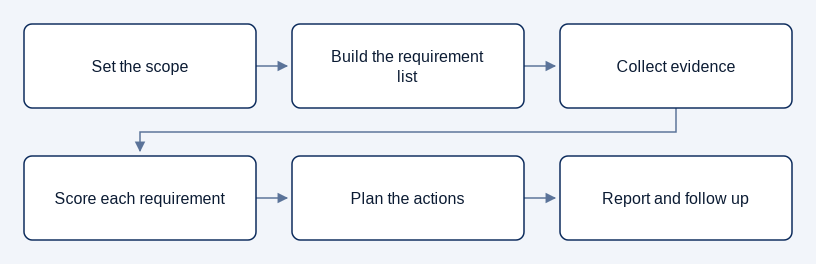
The six steps at a glance
Download the free gap analysis checklist (Excel)
It has 35 questions across clauses 4 to 10 of ISO 9001:2015, with columns for evidence, score, risk and actions. You can use it as it is or copy the questions into your own workbook.
Step 1: Set the scope
Write down which standard and edition you are measuring against, which sites, products and processes are in scope, and which teams own them. A clear scope stops the analysis from turning into a general review of everything.
Step 2: Build the requirement list
Break the standard into checkable requirements, grouped by clause (context, leadership, planning, support, operation, performance evaluation, improvement). Phrase each one as a question you can answer with evidence, for example: "Is there a documented process for evaluating and re-evaluating external providers?"
Step 3: Collect evidence, not opinions
For each requirement, look for proof: procedures, records, training files, audit reports, management review minutes, KPI dashboards. Interview process owners and walk through at least one real example per process. If it isn't recorded and can't be shown, treat it as not yet in place.
Step 4: Score each requirement
Use a simple, consistent scale:
| Score | Meaning |
|---|---|
| 0 | Not in place |
| 1 | Partly in place (exists but not documented, or documented but not followed) |
| 2 | In place and effective, with evidence |
Add a risk rating (high, medium, low) based on impact on product quality, customers and audit outcome.
Step 5: Turn gaps into an action plan
For every score below 2, record the action, owner, due date and the evidence that will prove it is closed. Fix high-risk gaps first, then group the rest by process so each owner gets one clear list.
Step 6: Report and follow up
Summarize results by clause and by process, with a one-page overview for management. Re-check closed actions before the audit, ideally through an internal audit.
How to plan the two or three weeks
A gap analysis for one site fits into three blocks of work. The durations below are for a small or mid-sized single site with one reviewer. A larger site needs more interview days.
| Block | What happens | Typical time |
|---|---|---|
| Preparation | Agree the scope, build the requirement list, ask process owners for their procedures and book the interviews | Two to three days |
| Fieldwork | Interview each process owner, walk the process, sample records, score as you go | One day for every two or three processes |
| Reporting | Check the scores for consistency, write the gaps, agree actions and owners, present to management | Three to four days |
Send the question list to each process owner a few days before the interview. It is an open-book exercise. The owner should arrive with the records at hand, and the hour is then spent reading evidence.
Hold a short meeting with management at the start and at the end. The first one explains what will happen and that scores are about the system and say nothing about individual people. The last one presents the result and gets the action owners confirmed while everyone is in the room.
How to interview a process owner
Start with the process, and leave the standard for later. Ask the owner to describe what comes in, what goes out, who does the work and how they know it went well. Most of the requirement questions answer themselves during that description, and the ones that do not are your follow-up.
Then ask for one real example and follow it. For purchasing, that might be the last order placed with a new supplier: how the supplier was chosen, what was sent to them, how the goods were checked on arrival. Read the records for that one order before you look at any others.
Write down the document number and date of everything you were shown. Three weeks later, when someone asks why supplier control scored 1, your notes are the answer.
Keep the scoring to yourself until the interview is over, then tell the owner what you plan to record and why. People accept a low score they have seen coming. A low score that first appears in the management report causes an argument about the method.
How to set the risk rating
The score says how far a requirement is from being met. The risk rating says how much that distance can hurt. A simple way to set it is to ask three questions about each gap.
| Question | Points to high risk when |
|---|---|
| Can it let a defective product or service reach a customer? | The gap is in inspection, release, calibration, supplier control or control of changes |
| Would a certification auditor grade it as a major nonconformity? | A required process is missing, or a process has broken down across the whole company |
| Has it already caused a complaint, a return or a late delivery? | There is a record of harm in the last twelve months |
One yes makes the gap medium risk. Two or more make it high. Everything else is low, and low-risk gaps can wait until the high and medium ones have owners and dates.
What evidence to look at, clause by clause
Most of the time in a gap analysis goes into finding and reading evidence. This table lists where to look first for each part of ISO 9001. Adjust it to your own processes.
| Clause area | Evidence to review |
|---|---|
| 4 Context | Scope statement, list of interested parties and what they require, process map with owners, inputs and outputs |
| 5 Leadership | Quality policy, assigned roles and authorities, minutes that show decisions made by top management |
| 6 Planning | Risk and opportunity register with the date of the last review, quality objectives with owners and measures, plans for changes |
| 7 Support | Competence and training records, calibration records, document control log, how people are told about policy and objectives |
| 8 Operation | Contract review records, design records if you design, supplier evaluations and re-evaluations, production and inspection records, records of nonconforming output |
| 9 Performance evaluation | KPI data, customer satisfaction results, internal audit program and reports, management review minutes |
| 10 Improvement | Corrective action log with root cause and a check that each action worked |
Take recent records. A procedure tells you what should happen. Last month's records tell you what did.
A worked example
Here is one requirement taken through the whole method, from question to closed action. The company and the numbers are an illustration.
The question is "Are external providers re-evaluated at planned intervals?" It comes from clause 8.4. The reviewer asks for the approved supplier list and picks five suppliers from it, including one added in the last year and one that had a delivery problem.
All five have an initial evaluation on file. Two have a re-evaluation. The purchasing procedure says every supplier is re-evaluated once a year, so three of the five are overdue. Nobody disputes this, because the forms are either in the folder or they are not.
The requirement scores 1: the process exists and is documented, and it is followed only in part. The risk rating is medium, because the company depends on two of the overdue suppliers for a machined part that goes into its main product.
The action reads: purchasing manager to re-evaluate all overdue suppliers by the end of next month and add the re-evaluation date to the approved supplier list. Closure evidence is the completed forms and the updated list. An internal auditor checks both before the certification audit.
That is the level of detail every gap needs. "Supplier management needs improvement" is not a finding anyone can act on.
Who should run the gap analysis
Someone who knows the standard and is not assessing their own work. In a small company that often means the quality manager covers most processes and another manager covers quality's own processes (document control, internal audit, corrective action).
An outside reviewer is worth the cost in three situations. The first is when nobody in the company has been through a certification audit. The second is when the last audit went badly and management wants an opinion that does not come from the people who built the system. The third is when the deadline is close and the quality manager cannot stop daily work for two weeks.
Process owners should always be in the room for their own area. They know where the records are, and they are the ones who will own the actions.
Gap analysis for the move to ISO 9001:2026
ISO published ISO 9001:2026 on September 16, 2026, and certified companies have until September 30, 2029 to move to it. If you already hold a certificate, you do not need to repeat a full gap analysis. Run a narrower one: list what changed between the 2015 and 2026 editions, and check only those requirements against your current system.
The new edition makes quality culture and ethical behavior explicit duties of top management. Expect that part of the analysis to rest on interviews and meeting records more than on procedures. See the ISO 9001:2026 transition checklist for the full list of changes.
Gap analysis when you add a second standard
The method does not change. The requirement list gets longer, and part of it is already answered.
For AS9100, ISO 13485 or IATF 16949, the ISO 9001 clauses are inside the sector standard, so a certified company starts with those rows scored and only works through the additions. For ISO 14001 or ISO 45001, the clause structure is the same as ISO 9001. Document control, internal audit, management review and corrective action can usually be shared, and the gap analysis concentrates on what is new: environmental aspects, hazards, legal requirements and emergency preparedness.
Mark shared processes in the workbook so that nobody builds a second document control procedure by mistake. See integrating management systems for how the combined system is usually structured.
What management should get at the end
Management does not need the workbook. It needs one page with four things on it.
The first is the overall picture: how many requirements were checked and how many scored 0, 1 and 2. The second is the list of high-risk gaps in plain words, each with its owner. The third is the date by which the system can be ready for an audit, given the actions on the list. The fourth is what the plan needs from management, such as a day a week of someone's time, a calibration contract, or a decision that has been waiting.
Everything else goes in the appendix. If the one page is clear, the follow-up meetings are short.
Mistakes that waste the exercise
The most common one is scoring from the procedure. If the reviewer reads the document and never opens a record, every documented process scores 2 and the analysis finds nothing.
The second is letting owners score themselves. People rate their own area higher than a colleague would. Have someone else score, with the owner present.
The third is writing findings nobody can close. Each gap needs one action, one owner and one piece of closure evidence. A finding that lists four problems will stay open.
The last is stopping at the report. The value is in the closed actions. Put the action list on the agenda of a monthly meeting until it is empty.
Common gaps we see
- Risks and opportunities identified once and never updated.
- Supplier evaluation done at onboarding only, with no re-evaluation.
- Management review held but missing required inputs or decisions.
- Training records that show attendance, not competence.
- Corrective actions closed without checking that they worked.
- KPIs tracked without targets or follow-up.
Gap analysis checklist structure
Use this structure for your own checklist or workbook:
- Requirement (as a question)
- Clause reference
- Evidence reviewed
- Score (0–2) and risk rating
- Gap description
- Action, owner, due date
- Closure evidence and date
Frequently Asked Questions
How long does a QMS gap analysis take?
For a single-site small or mid-sized company, typically one to three weeks including interviews and reporting.
Can we do it ourselves?
Yes, if someone who knows the standard leads it and you work from evidence. An independent reviewer helps when you need an outside view before a certification audit.
Is a gap analysis the same as an internal audit?
No. A gap analysis measures you against a standard you may not fully meet yet. An internal audit checks that an established system works as planned.
What about medical devices?
For ISO 13485 the method is the same, but the requirement list adds device-specific items such as design controls, risk management linked to ISO 14971, and regulatory reporting.
How many records should we sample?
ISO 9001 does not set a number. Three to five recent examples per process is a common starting point. Take more where the first few show a problem, and always include at least one case that went wrong, such as a complaint or a late delivery.
What should the gap analysis report contain?
A one-page summary with scores by clause, the list of gaps with risk ratings, and the action plan with owners and dates. Keep the evidence notes as an appendix so that an auditor or a new quality manager can see how each score was reached.
How often should we repeat it?
Once before first certification, and again when something large changes: a new edition of the standard, a new site, an acquisition, or a second standard. Between those events, internal audits do the same job on a rolling basis.
Related insights
- ISO 9001 Internal Audit: Program, Plan and Checklist
- ISO 9001:2026 Transition Checklist: 12 Steps Before Your Transition Audit
- Is Your QMS Ready for an Audit? A Pre-Audit Checklist for Quality Leaders
- QMS Gap Analysis tool
Get a head start
The ElevateQCS ISO 9001:2026 implementation kit includes a Transition Workbook, a QMS Records Workbook, procedures and templates aligned with ISO 9001:2026, so you can close the gaps with ready-to-adapt documents. Explore the ISO 9001:2026 kit
Need someone to lead it? Find a vetted quality expert.
This article is general guidance aligned with ISO 9001. It is not a substitute for the standard itself or a certification body's requirements.
Sources
These references provide standards, regulatory text, or background context. They do not independently validate every recommendation in this article. Linking does not imply endorsement. Standards may require purchase; refer to the publisher for the current text.
