

AS9100 (also published as EN 9100 and JIS Q 9100) is the aerospace quality management standard. It contains all of ISO 9001 plus aerospace and defense requirements, so audit preparation means proving both a working ISO 9001 system and the aerospace additions. Certification audits follow the IAQG 9101 audit method, which looks closely at process effectiveness and performance, not just documents.
Its successor, IA9100, had not been published by early November 2026, and the IAQG has announced no publication date or transition period. AS9100D is the edition you are audited against today.
What AS9100 adds to ISO 9001
- Product safety: processes to identify and manage product safety throughout the product life cycle.
- Counterfeit part prevention: controls to prevent, detect and handle counterfeit or suspect parts, including supplier and purchasing controls.
- Configuration management: identifying and controlling product configuration across its life.
- Operational risk management: risks to meeting product and service requirements, managed throughout operations.
- On-time delivery and product conformity performance: measured and acted on.
- First article inspection (FAI): verification that a new or changed production process produces conforming product.
- Special requirements and critical items: identified and controlled.
- Human factors in nonconformity and corrective action.
- Awareness: people understand their contribution to product safety and conformity and the importance of ethical behavior.
- Flow-down of requirements to suppliers, including key characteristics and customer requirements.
The audit method you are preparing for
A first certification has two stages: a readiness review, then the full audit of every process. What happens in an AS9100 audit covers both stages and how findings are graded. For other kinds of audit you may face, such as customer and Nadcap audits, see aerospace audits explained. This page is about getting ready, and the first thing to understand is the audit method.
The method comes from the 9101 standard, and it differs from a plain ISO 9001 audit in one way that surprises people. For each product realization process, the auditor records whether the process is reaching its planned results. This goes into a process effectiveness assessment report, known as a PEAR. A process that follows its procedure and still misses its delivery or quality targets gets a poor rating.
Audit results are entered in OASIS, the IAQG database that aerospace customers use to check supplier certificates. Your customers can see that you are certified and by whom.
What auditors ask to see
Clause numbers below are from AS9100D.
| Requirement | Clause | What to have ready |
|---|---|---|
| Operational risk management | 8.1.1 | Risks for current orders and programs, with actions and owners |
| Configuration management | 8.1.2 | How a drawing revision reaches the shop floor; one recent change traced end to end |
| Product safety | 8.1.3 | How safety hazards are identified and reported; training records |
| Counterfeit part prevention | 8.1.4 | Approved sources, receiving checks, and what happens to a suspect part |
| Flow-down to suppliers | 8.4.3 | Purchase orders that carry customer requirements, key characteristics and right of access |
| First article inspection | 8.5.1.3 | FAI reports for new parts and for parts made after a process, tooling or site change |
| On-time delivery and conformity | 9.1.2 | Twelve months of data, with the actions taken when results fell short |
Auditors pick their own samples. Have the records organized so that any order from the past year can be pulled in a few minutes.
Special processes and Nadcap
AS9100 requires you to validate special processes such as heat treatment, welding, plating and non-destructive testing, whether you run them yourself or buy them. Nadcap accreditation is a different thing. It is a customer requirement that many primes put in their contracts, and AS9100 does not ask for it. Check your customers' supplier requirements to see which of your processes, or your subcontractors' processes, need it.
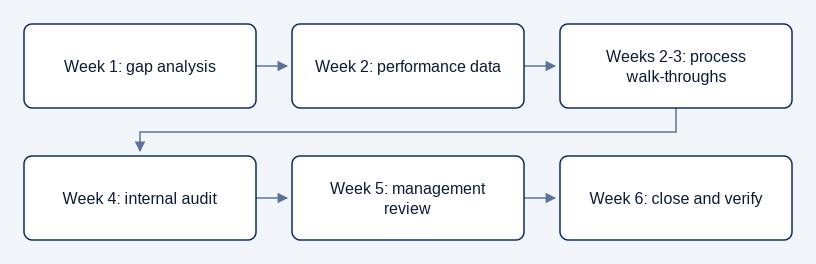
The readiness plan at a glance
Download the free AS9100 audit readiness checklist (Excel)
It has 19 checks with AS9100D clause numbers and columns for evidence, actions and owners.
A 6-week readiness plan
- Week 1, gap analysis: check each requirement against evidence. Prioritize aerospace-specific items.
- Week 2, performance data: pull 12 months of on-time delivery, conformity and customer scorecards. Auditors will ask how you respond to poor results.
- Weeks 2–3, process walk-throughs: trace two real orders from contract review to delivery, including FAI, special processes and supplier flow-down.
- Week 4, internal audit: audit every process, using the process-approach style the certification audit will use.
- Week 5, management review: cover all required inputs and record decisions and actions.
- Week 6, close and verify: close findings and verify corrective actions are effective.
The internal audit before the certification audit
Week 4 of the plan is the step that decides how the real audit goes. An internal audit run as a paperwork check finds paperwork problems. Run it the way the certification auditor will.
Audit by process, and start each one with its measures. Ask the process owner what the targets are, what the last twelve months look like and what was done when results fell short. Only then go to the procedure and the records. This is the order a 9101 audit follows, and it is the part companies moving up from ISO 9001 find hardest.
Cover the aerospace additions in every process they touch. Counterfeit part prevention is a purchasing topic and also a receiving, stores and production topic. Product safety belongs in design, production and training. Configuration management runs from contract review to the shop floor.
Include your customers' requirements in the audit criteria. Many findings in aerospace audits come from a customer's supplier quality manual, and the standard itself was met. Pull the quality clauses from your three largest customers and sample against them.
Use auditors who are independent of the process. In a small shop that can mean trading auditors with another company or hiring one for the week. Write the findings up with the same grading the certification body uses, so that management sees the result in the form it will take later.
Reading your customer scorecards before the auditor does
Most primes send suppliers a scorecard with delivery and quality ratings. Auditors ask for them, because they show how the customer sees your performance, and clause 9.1.2 asks you to monitor exactly that.
Collect the last twelve months of scorecards from each customer that issues one. For every rating below the customer's target, have the cause and the action ready. If your own delivery figure differs from the customer's, find out why before the audit. The usual reasons are different definitions of the due date or of what counts as delivered.
If a customer has put you on a watch list or asked for a recovery plan, bring that into management review and keep the correspondence with the plan. An auditor who learns about it from the scorecard, with nothing in your own records, will look much harder at everything else.
The week before the audit
By this point the system is what it is. Use the last week for logistics.
Confirm the audit plan with the certification body and tell each process owner when they are up. Check that the people named in the plan are on site that day, including second shift if it is in scope.
Walk the shop floor with the question an auditor would ask at each station: which revision are you working to, and how do you know it is current? Remove uncontrolled copies of drawings and work instructions.
Close what you can from the internal audit, and have a dated plan for anything still open. An open finding with an owner and a date is normal. An open finding nobody has looked at is a second finding.
Common AS9100 audit findings
- Counterfeit part controls written but not applied in purchasing or receiving.
- Supplier flow-down incomplete (key characteristics, special processes, right of access).
- FAI not repeated after process, tooling or location changes.
- On-time delivery tracked but no actions when it drops.
- Risk register covering business risks but not operational/product risks.
- Corrective actions that skip human factors or never verify effectiveness.
- Configuration changes not reflected in work instructions on the shop floor.
How to fix the seven common findings
Each finding in the list above has a usual cause, and the fix follows from it.
Counterfeit part controls that exist only on paper usually mean purchasing and receiving were not involved when the procedure was written. Sit with both teams and go through one incoming shipment from a distributor. Check that the source was on the approved list, that the certificate of conformance was reviewed, and that receiving knows what makes a part suspect and where to put it.
Incomplete flow-down comes from purchase order templates. Add the customer's quality clauses, key characteristics and right of access to the template or to a standard attachment, and then review the open orders with your ten largest suppliers against it.
Missing repeat first article inspections come from change control. A new FAI is needed for a new part, and also when the design, the process, the tooling, the source or the location changes, or after a long break in production. Add an FAI question to the engineering change form so that nobody has to remember it.
On-time delivery without action is a management review problem. Auditors accept a poor number with a recorded cause and an action. They do not accept twelve months of the same poor number with nothing next to it.
A risk register that stops at business risks needs a second section for operational risk under clause 8.1.1: risks to delivering each program or large order, reviewed at contract review and during production.
Corrective actions that skip human factors can be fixed with one field on the form. Ask whether fatigue, distraction, unclear instructions or time pressure played a part, and what was done about it. Retraining is only an answer if the person did not know what to do.
Shop floor documents at the wrong revision are found by walking the floor. Do it monthly with the document register in hand, and make each cell leader responsible for their own area.
What a counterfeit parts program contains
Expect questions on this in the audit. A program that holds up has the following parts.
- A rule on where parts may be bought: the original manufacturer or its authorized distributors first, and a defined approval step for any other source.
- Checks at receiving that fit the risk, from reviewing paperwork and markings up to testing for parts bought outside authorized channels.
- A quarantine area and a rule that suspect parts are never returned to the supplier, where they could be sold again.
- Reporting of confirmed counterfeit parts to the customer and to the industry reporting scheme your customers use.
- Training for purchasing, receiving and inspection staff, with records.
- The same requirements passed to your suppliers in purchase orders.
If you buy only raw material and machine it yourself, the program can be short. If you buy electronic components, it needs the full list.
Preparing people for audit interviews
AS9100 auditors talk to operators, inspectors and buyers, and they spend little time in the conference room. You cannot script the answers and should not try. You can make sure people know four things.
They should know where their current work instruction and drawing are, and how they can tell the revision is current. They should know what to do with a part that looks wrong. They should know how their work affects product safety, in one sentence of their own. And they should know that "I don't know, but I know who does" is a good answer.
Tell them to answer the question that was asked and then stop. Long answers lead to new questions, and guesses become findings.
What to ask from a pre-audit
A pre-audit, sometimes called a gap audit, is a practice run a few weeks before the certification audit. If you bring in an outside auditor for it, ask for three things in writing.
Ask that the audit follows the process approach the certification audit will use, including a view on whether each process is reaching its targets. Ask for findings graded the way a certification body would grade them, as major or minor, with the evidence. And ask for a closing discussion with the management team, because the graded list alone does not tell you what to fix first.
Leave at least four weeks between the pre-audit and the real one. Less than that, and there is no time to close what it finds. For how the certification audit itself runs, day by day, see what happens in an AS9100 audit.
See AS9100 Internal Audit: How to Plan, Run and Report It
Frequently Asked Questions
How long does AS9100 preparation take?
For an ISO 9001-certified company, often three to six months; starting from scratch typically takes longer.
What is AS9100D?
The current published revision of AS9100, and the one certification audits use. Its successor, IA9100, had not been published by early November 2026.
Who can help?
An experienced AS9100 auditor or implementer can run a pre-audit and help close gaps.
Do we need AS9100, or is ISO 9001 enough?
It depends on your customers. Most aerospace primes and many of their tier-one suppliers require AS9100 from companies that make or process flight hardware. If no customer contract asks for it, ISO 9001 may be enough for now.
What happens if the auditor finds a major nonconformity?
You contain the problem, find the root cause and submit corrective action within the time your certification body sets. The certificate is not issued until major nonconformities are closed, and the auditor may return to check.
What is a PEAR?
A process effectiveness assessment report. The auditor completes one for each product realization process and rates whether the process is reaching its planned results, using your own measures such as on-time delivery and conformity.
Can we combine the AS9100 audit with our ISO 9001 audit?
AS9100 contains ISO 9001, so a company certified to AS9100 does not need a separate ISO 9001 audit. Certification bodies can issue both certificates from the one audit if you need the ISO 9001 certificate for customers outside aerospace.
Related insights
- What happens in an AS9100 audit? Stages, findings and the three-year cycle
- How to Hire an AS9100 Lead Auditor: Scope, Aerospace Experience and Recognition
- Aerospace audits explained: the five types and who performs them
Get expert support
Preparing for an AS9100 certification or surveillance audit? ElevateQCS matches aerospace companies with vetted, independent AS9100 auditors and implementers for gap analysis, internal audits and pre-audit readiness. Find an AS9100 expert
General guidance. AS9100/EN 9100 is a copyrighted standard; refer to your purchased copy and your certification body for exact requirements.
Sources
These references provide standards, regulatory text, or background context. They do not independently validate every recommendation in this article. Linking does not imply endorsement. Standards may require purchase; refer to the publisher for the current text.
