
The Next Evolution of Compliance Advisory
For the past decade, compliance advisory has operated on a consultative model — organizations engage advisors, receive assessments, and implement recommendations manually. The process works, but it does not scale. It does not provide continuous visibility. And it does not leverage the computational power now available to governance professionals.
ElevateQCS is changing this.
We are engineering a purpose-built AI Governance Platform — five integrated modules designed to transform how regulated organizations identify compliance gaps, monitor regulatory change, classify AI risk, calculate carbon exposure, and prepare for certification audits.
This is not a speculative product roadmap. These are tools built on the same operational compliance architecture and quality management discipline that has governed our advisory practice since inception.
Module 1: AI Compliance Gap Analyzer
This is the flagship tool — and the most impactful.
What It Does
Organizations upload their existing documentation:
- Quality management policies
- Operational procedures
- Governance frameworks
- Supplier compliance policies
- AI documentation and model cards
The AI engine analyzes these documents against international standards and regulatory frameworks, identifying precisely where organizations fall short.
Standards Coverage
The analyzer maps documentation against:
- ISO 9001 — Quality management systems
- ISO 14064 — Greenhouse gas quantification and reporting
- ISO 42001 — AI management systems
- ISO 27001 — Information security management
Output
The system produces a comprehensive compliance gap report:
| Deliverable | Description |
|---|---|
| Compliance Gap Report | Clause-by-clause analysis against selected standards |
| Missing Controls Matrix | Specific controls absent from current documentation |
| Audit Readiness Score | Quantified readiness percentage with confidence intervals |
| Recommended Actions | Prioritized remediation roadmap with effort estimates |
Why This Tool Matters
Current compliance diagnostics require manual analysis by experienced auditors — a process that takes weeks and costs thousands in consulting fees. The AI Compliance Gap Analyzer delivers a comparable initial assessment in hours, enabling organizations to understand their compliance posture before engaging advisory resources.
This becomes the AI Compliance Diagnostic — the entry point to the ElevateQCS advisory relationship.
Module 2: EU Regulatory Monitoring AI
Regulatory environments are not static. Organizations operating across European markets face a continuously shifting compliance landscape — and most discover regulatory changes only after enforcement actions begin.
Regulations Monitored
The monitoring engine tracks changes across the most consequential regulatory frameworks affecting ElevateQCS clients:
- EU AI Act — Risk classification, deployer obligations, prohibited practices
- Corporate Sustainability Reporting Directive (CSRD) — ESG disclosure requirements
- Corporate Sustainability Due Diligence Directive (CS3D) — Supply chain due diligence obligations
- EU Carbon Border Adjustment Mechanism (CBAM) — Emissions reporting for cross-border trade
Features
- Automated Regulatory Updates — Real-time tracking of regulatory amendments, guidance documents, and enforcement actions
- Compliance Alerts — Tailored notifications based on organization profile, industry sector, and jurisdictional exposure
- AI-Generated Summaries — Plain-language interpretations of complex regulatory texts
- Client-Specific Impact Analysis — Algorithmic assessment of how regulatory changes affect specific organizational obligations
Why This Tool Is Powerful
Organizations currently rely on legal newsletters, industry associations, and periodic advisor briefings to track regulatory change. This creates a dangerous latency — by the time most companies learn about a regulatory shift, early adopters have already begun compliance implementation.
The EU Regulatory Monitoring AI converts this from a periodic awareness exercise into a continuous intelligence service.
Module 3: AI Governance Risk Classifier
The EU AI Act requires organizations to classify their AI systems by risk tier — and the consequences of misclassification are severe: fines up to €35 million or 7% of global annual turnover.
The Problem
Thousands of companies deploying AI systems do not know whether their systems fall into high-risk categories under Article 6 of the EU AI Act. The classification analysis requires deep understanding of:
- Annex III high-risk use cases
- Article 8–15 compliance obligations
- Deployer vs. provider responsibilities
- Data governance requirements under Article 10
How It Works
Organizations provide:
- AI model documentation and technical specifications
- Product descriptions and deployment contexts
- Data usage policies and training data provenance
- Operational scope and jurisdictional footprint
Output
The classifier determines:
| Assessment Area | Output |
|---|---|
| AI Risk Category | Minimal, Limited, High-Risk, or Unacceptable classification |
| High-Risk Indicators | Specific Annex III triggers identified in deployment context |
| Required Controls | Mandatory compliance obligations for the assigned risk tier |
| Documentation Requirements | Precise documentation gaps against Article 11 requirements |
| Governance Roadmap | Step-by-step implementation plan for required governance structures |
This tool extends our existing EU AI Act Classifier into a comprehensive governance assessment — moving beyond simple classification into actionable compliance planning.
Module 4: CBAM Emissions Calculator
The EU Carbon Border Adjustment Mechanism is transforming international trade compliance. Exporters of steel, aluminum, cement, fertilizers, electricity, and hydrogen into the EU must now report embedded emissions — and beginning in 2026, purchase CBAM certificates reflecting the carbon price differential.
Inputs
Organizations enter:
- Production data — Manufacturing processes, energy consumption, material inputs
- Energy usage — Grid electricity mix, on-site generation, renewable energy certificates
- Supplier emissions — Scope 1, 2, and 3 emissions from upstream supply chain partners
Framework Alignment
The calculator operates within established carbon accounting frameworks:
- ISO 14067 — Carbon footprint of products
- ISO 14064 — Greenhouse gas quantification at organizational and project levels
- EU CBAM Implementing Regulation — Specific calculation methodologies and reporting formats
Output
| Deliverable | Description |
|---|---|
| Product Carbon Footprint | Emissions intensity per unit of production |
| Embedded Emissions Report | Total embedded emissions for CBAM-eligible products |
| CBAM Reporting Draft | Pre-formatted report aligned with EU submission requirements |
| Supply Chain Emissions Map | Visual mapping of emissions concentration across supplier tiers |
Target Market
This tool serves companies exporting CBAM-covered goods:
- Steel and iron products
- Aluminum and aluminum products
- Cement and clinker
- Fertilizers (nitrogen-based)
- Electricity generators
- Hydrogen producers
The environmental procurement and supply chain governance infrastructure we have built positions this calculator as a natural extension of our advisory capability.
Module 5: AI-Powered Audit Preparation System
Certification audits remain one of the highest-anxiety events in organizational life. Companies spend months preparing documentation, training personnel, and conducting internal reviews — often discovering critical gaps days before the external auditor arrives.
Standards Coverage
The audit preparation system covers:
- ISO 9001 — Quality management systems
- ISO 42001 — AI management systems
- ISO 27001 — Information security management
Features
- Audit Checklist Generator — AI-generated, clause-specific checklists tailored to organizational scope and certification body requirements
- Evidence Tracker — Document management system linking evidence artifacts to specific standard clauses
- Document Repository — Centralized storage with version control, access logging, and audit trail
- AI Audit Simulation — Simulated audit interviews using AI-generated auditor questions based on organizational documentation and common audit failure patterns
Output
| Deliverable | Description |
|---|---|
| Audit Readiness Score | Quantified percentage with clause-level breakdown |
| Missing Documentation Report | Specific documents and records required but absent |
| Improvement Roadmap | Prioritized actions ranked by audit risk severity |
| Simulation Transcript | AI-generated audit interview with findings and recommendations |
This module builds directly on our existing QMS Gap Analysis and Public Sector Readiness Assessment — elevating static assessments into dynamic, AI-driven preparation systems.
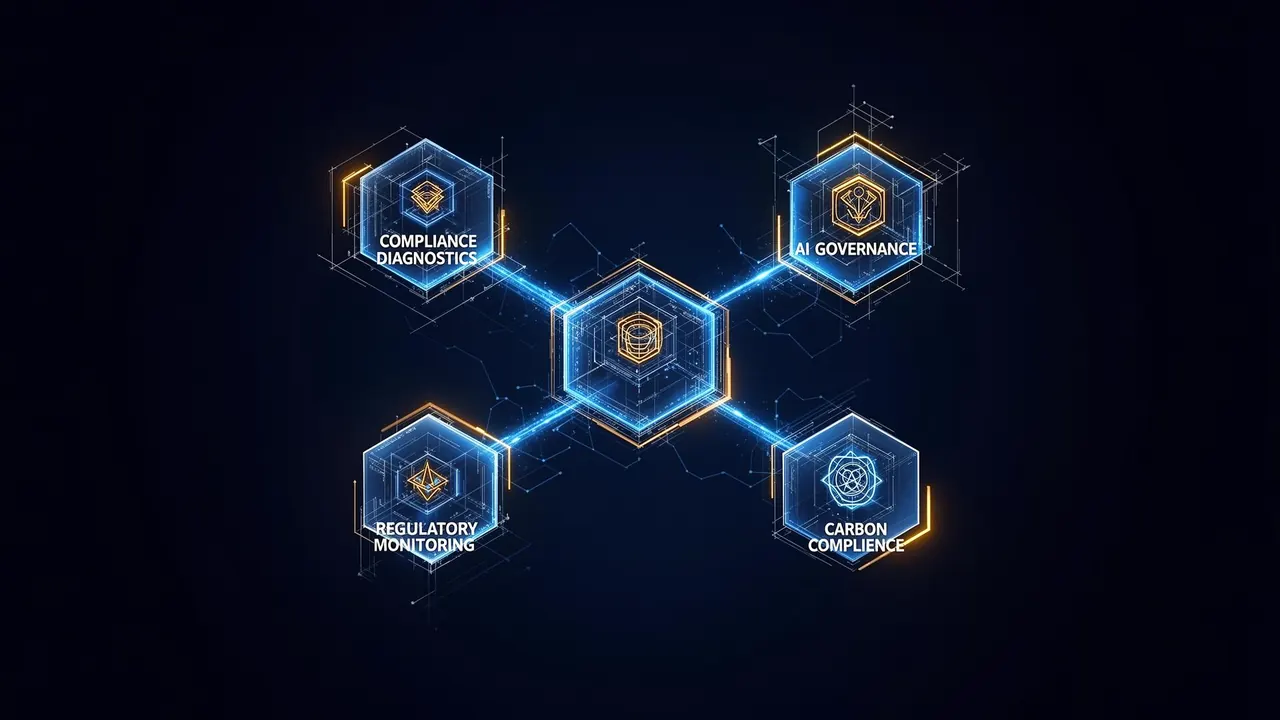
The Unified Vision: ElevateQCS Governance Platform
These five modules are not isolated tools. They form the architecture of an integrated governance platform:
ElevateQCS Governance Platform
| Module | Capability | Integration |
|---|---|---|
| 1. Compliance Diagnostics | AI Compliance Gap Analyzer | Feeds audit preparation and regulatory monitoring |
| 2. Regulatory Monitoring | EU Regulatory Monitoring AI | Updates compliance diagnostics with new requirements |
| 3. AI Governance | AI Governance Risk Classifier | Links to compliance diagnostics for AI-specific controls |
| 4. Carbon Compliance | CBAM Emissions Calculator | Integrates with supply chain data from compliance diagnostics |
| 5. Audit Preparation | AI-Powered Audit Preparation | Consumes outputs from all four preceding modules |
This is not a collection of point solutions. It is an AI-powered governance SaaS — a platform where each module feeds intelligence to the others, creating a continuous compliance feedback loop.
What This Means for Companies We Work With
For Public Sector Contractors
Public Sector organizations gain automated compliance diagnostics that map directly to FAR/DFARS flowdown requirements, CMMC certification preparation, and Alliant 3 readiness.
For EU-Regulated Companies
Organizations facing EU AI Act obligations, CS3D due diligence, and CBAM reporting requirements gain a single platform that monitors, classifies, calculates, and prepares — replacing fragmented advisory engagements with continuous intelligence.
For High-Growth Companies
Startups approaching investor-ready operations and early-stage QMS development gain institutional-grade governance tools at a fraction of traditional advisory costs — enabling them to demonstrate compliance as a funding advantage.
For Multi-Jurisdictional Operations
Organizations operating across multiple regulatory jurisdictions gain a single source of truth for cross-border compliance obligations, eliminating the fragmented monitoring that creates international compliance gaps.
The Approach: Built With Institutional Precision
Every module in this platform is built on the same foundational principles that govern our advisory practice:
- Standards-First Architecture — Every output maps to specific international standard clauses, not generic recommendations
- Audit-Grade Documentation — Every assessment produces documentation that meets external audit requirements
- Continuous Improvement Integration — Every module feeds a CAPA loop that drives ongoing remediation
- Human-in-the-Loop Governance — AI augments professional judgment; it does not replace the human oversight that regulated industries require
This is not artificial intelligence replacing compliance professionals. This is artificial intelligence amplifying their capability — extending the reach of institutional expertise into continuous, scalable governance operations.
Frequently Asked Questions
When will the ElevateQCS AI Governance Platform be available?
The AI Compliance Gap Analyzer is in active development and expected to launch in Q3 2026. Subsequent modules will follow in quarterly releases through 2027, with the full integrated platform operational by Q1 2027.
How does the AI Compliance Gap Analyzer differ from your existing diagnostic tools?
Our current diagnostic suite provides interactive self-assessments based on structured questionnaires. The AI Compliance Gap Analyzer accepts actual organizational documents — policies, procedures, governance frameworks — and performs automated clause-by-clause analysis against international standards, producing audit-grade compliance gap reports.
Will these tools replace traditional advisory engagements?
No. These tools augment advisory capability by automating initial assessments and providing continuous monitoring. Complex remediation, organizational change management, and certification preparation still require principal-led advisory engagement. The platform creates more informed advisory conversations, not fewer.
What standards and regulations does the platform cover?
The initial release covers ISO 9001, ISO 42001, ISO 27001, ISO 14064, ISO 14067, the EU AI Act, CSRD, CS3D, CBAM, and FAR/DFARS compliance frameworks. Additional standards will be added based on client demand and regulatory developments.
How is data security handled for uploaded documents?
All document processing occurs within encrypted, isolated environments. Uploaded documents are not used for AI model training. The platform maintains SOC 2 Type II compliance and implements data residency controls for organizations with jurisdictional data requirements.
Can the platform integrate with existing compliance management systems?
The platform is designed with API-first architecture, enabling integration with existing GRC platforms, document management systems, and enterprise resource planning tools. Custom integrations are available for enterprise clients.
The ElevateQCS Governance Platform represents our commitment to scaling institutional-grade compliance intelligence. For early access or to discuss how these capabilities align with your organization's governance needs, tell us what kind of expert you need or reach us at [email protected].
Sources
These references provide standards, regulatory text, or background context. They do not independently validate every recommendation in this article. Linking does not imply endorsement. Standards may require purchase; refer to the publisher for the current text.
